Le Cénacle
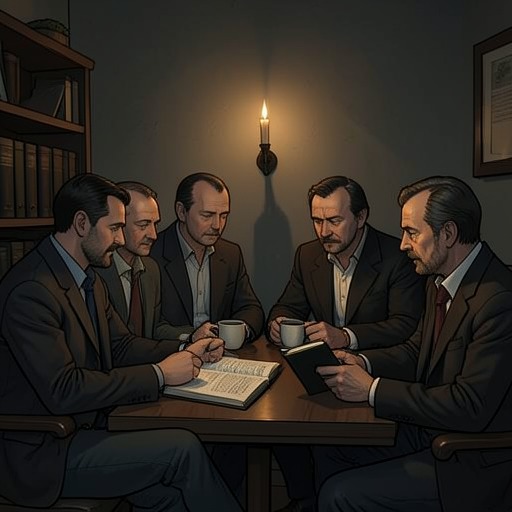
Illusions perduesLe Cénacle is a literary and artistic circle bound by friendship, intellectual seriousness, and a demanding idea of conscience. Its members offer Lucien de Rubempré both tangible support and an ethical standard: they would rather publish a journal devoted to truth and justice than win an audience by adapting themselves to the market. As Lucien edges toward journalism and the social world it brings with it, the circle becomes a measure of what he may be leaving behind—and, in a later gathering, a witness to the distance between its ideals and the press’s working methods.
Identity and Ethical Commitments
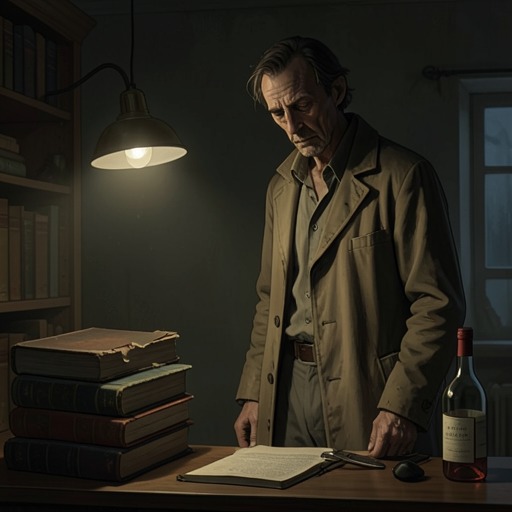
The circle gathers around Daniel d'Arthez and includes, among the members named in these scenes, Michel Chrestien, Bianchon, Fulgence Ridal, Léon Giraud, Joseph Bridau, and Meyraux. It is presented not merely as a group of acquaintances but as a community with a shared moral vocabulary. Its members value honor, intellectual independence, and the responsibility not to injure others for an easy effect. When Lucien arrives at Daniel’s rooms, he finds the friends—Meyraux has just gone out—overcome by news of a catastrophe. Their grief is collective: the absent or lost figure is remembered as a beloved friend and a light to them for two years. The scene establishes the seriousness of their attachments, even though the information given here does not identify the catastrophe’s full circumstances.
The circle’s ideals are expressed most clearly by Daniel. He describes a clean conscience as a daily source of strength: a writer should be able to look back on the day without having judged another’s work unjustly, wounded an innocent person, sacrificed someone’s happiness to a joke, or betrayed personal convictions. The force of this standard lies in its particulars. It is not a general preference for good intentions, but a refusal to make another person’s suffering the raw material of literary or journalistic triumph. Daniel’s language gives the circle’s ethical position a practical test, one that Lucien recognizes even as he begins to doubt that he can live by it.
Aid to Lucien and the Threat of Journalism
Lucien comes to Daniel’s rooms with gratitude for his friends. He describes their help through the image of turning base metal into gold, and Bianchon and Fulgence answer that the pleasure was theirs. Their exchange presents assistance as reciprocal friendship rather than a debt to be claimed. Yet the warmth of the welcome is unsettled by news of Lucien’s journalistic debut: Léon Giraud has heard its noise in the Latin Quarter. Lucien insists that he is not yet a journalist, but that distinction offers little reassurance. The group’s fear is not simply that he has taken a new job; it is that the habits of the press will draw him into judgments and attacks incompatible with the conscience Daniel describes.
Lucien argues that a person might work for a newspaper without abandoning such principles, and that necessity could leave him no other way to live. Fulgence hears this as a first concession. Giraud responds by proposing a different course: the circle intends to publish a journal in which neither truth nor justice would be insulted, and through which ideas useful to humanity could be spread. The proposal makes the group’s ethic institutional as well as personal. Its members are not content to condemn the existing press; they imagine making an alternative. Lucien immediately predicts that it will have no subscribers. Michel Chrestien counters that five hundred readers of the right kind would be worth five hundred thousand, while Daniel says that devotion, rather than capital, is what the project requires. Their disagreement turns on what makes a journal valuable: reach and money, or the commitment of the people who sustain it.
Lucien’s Social Choices and the Circle’s Judgment
The conversation also brings Lucien’s new social life into view. Michel Chrestien mocks the luxury surrounding him, recalling a highly polished carriage, fashionable horses, and Coralie, whose relationship with Camusot is part of the discomfort. Lucien asks whether there is anything wrong with this display. The exchange makes visible the collision between the circle’s standards and the material signs of his ascent. The carriage and the celebrated actress signify access to a world the friends regard with suspicion; Lucien, meanwhile, is already anxious that they will despise him when they learn that he must endure Camusot’s presence.
Michel’s rebuke is deliberately severe. He allows that Lucien may become a great writer but judges that he risks remaining a small-time joker. He leaves rather than soften the warning. Bianchon calls Michel’s bluntness painful but salutary, like a dentist’s forceps, and suggests that Michel sees Lucien’s likely future and may already be grieving for him. Daniel takes the gentler role, trying to restore Lucien’s spirits. After an hour, however, Lucien leaves the circle with his conscience still accusing him of the path he may take. He looks back at the faintly lit windows of Daniel’s rooms and fears that his embrace from these true friends may have been the last.
That fear gives the circle’s response a personal cost. Lucien does not simply reject an abstract code: he risks estrangement from people whose support has mattered to him. On returning to his lodging, he finds Coralie there in tears, putting his shirts, gloves, ties, and handkerchiefs into the shabby chest of drawers. Her willingness to share his poverty makes his situation more complicated, not less. The contrast sharpens the question raised among his friends: whether love and gratitude can survive the compromises demanded by his new ambitions.
The Circle in Contact with the Press
At a later gathering at Lucien’s, the circle appears in a changed social arrangement. Florine, Étienne Lousteau, Matifat, and Camusot are there, and the guests are arranging gaming tables. The people around Lucien already call themselves his friends. Play runs from nine until midnight; Lucien does not know any of the games, while Lousteau loses a thousand francs and borrows the money from him. Around ten, Michel Chrestien, Fulgence Ridal, and Joseph Bridau arrive. Lucien finds their faces cold and serious, almost constrained. Daniel is absent, working on his book, and Giraud is occupied with publishing the first issue of his review. The circle has sent three of its artists, who are expected to feel less out of place amid the revelry than the others. Their presence therefore represents the group, but does not erase the difference between its purpose and the company assembled around Lucien.
Near midnight, the gathering becomes an orgy of talk as well as sociability. The guests do not recognize the divergence between the three representatives of the circle and the newspaper men. The argument makes that division explicit. Claude Vignon defends a dignified conception of criticism and condemns the small papers’ turn toward personal attacks, warning that writers who practice it will eventually discredit themselves. Lousteau, Hector Merlin, and Finot openly defend the practice known in journalistic slang as the blague: in their account, insults operate as a punch that marks out genuine talent, and great public praise ought to be accompanied by a chorus of abuse. The dispute exposes two rival accounts of criticism. For Vignon, personal attack degrades the critic and the writer; for the journalists, it is part of the trial by which talent proves its strength.
Narrative Significance
Le Cénacle serves as both Lucien’s refuge and the ethical counterweight to his entry into journalism. Its members’ support is generous, but their generosity does not make their judgment easy to bear: they can help him materially while refusing to bless the choices that accompany his social advancement. The planned journal gives their ideals a possible public form, while the later debate shows how far those ideals stand from a press that treats insult as an instrument of publicity. Between the grieving circle, the proposed journal, and the midnight argument, the group’s principles are tested not in isolation but against Lucien’s need to live, his attachment to Coralie, and the appeal of a world where reputation is made in public.